The seven levels of consciousness
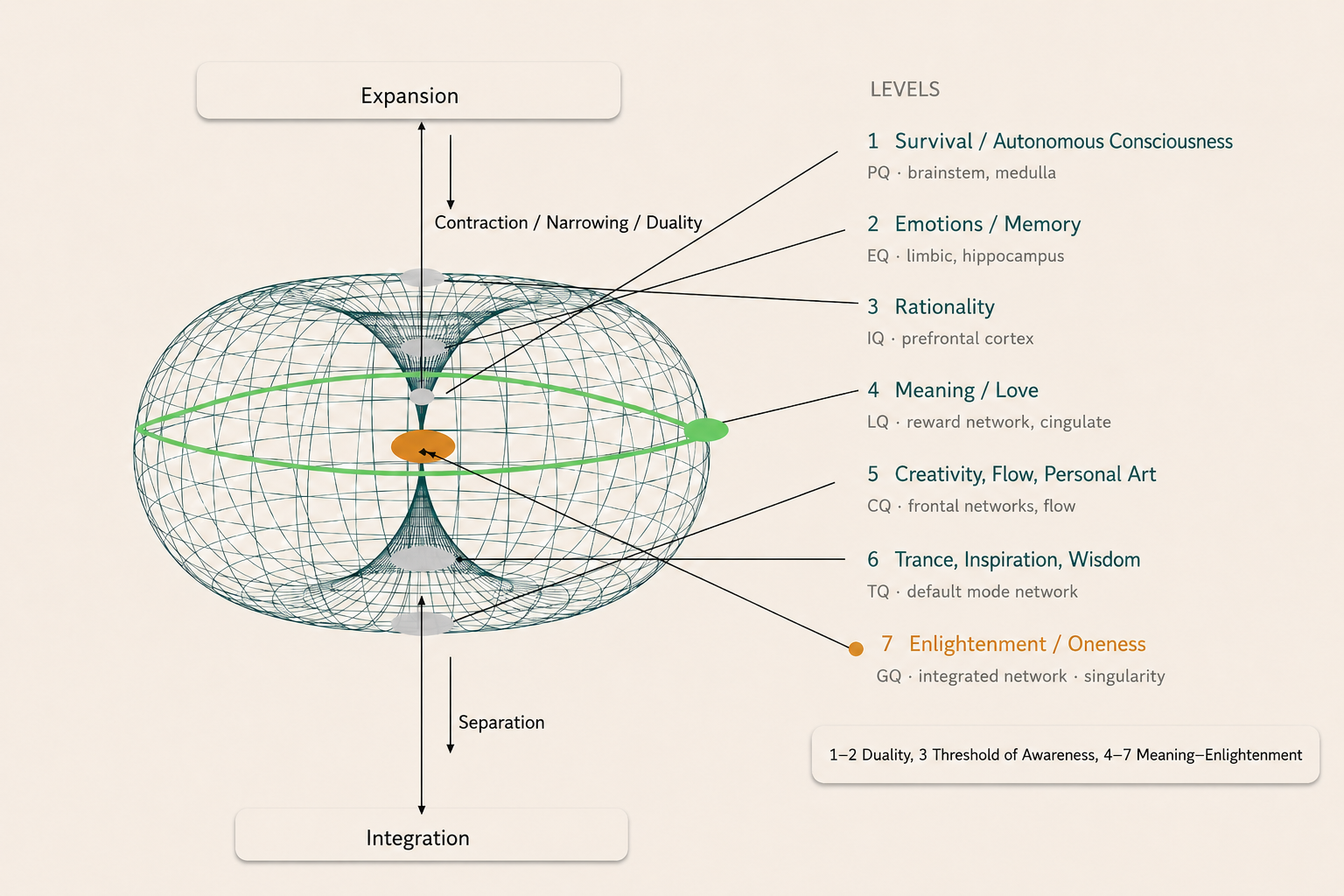
PFA reads consciousness across seven functional levels. Each level is paired with a structure in the brain, a type of intelligence and a stage of development. All seven are active in everyone, all of the time.
- L1
Survival
Physiological Intelligence (PQ)Brain stemThe oldest layer: breath, hunger, sleep, safety, the split between threat and resource. Its intelligence is the body's billions-of-years-old survival programme. It does not deliberate; it reacts — and it is right to. Everything else rises on the ground it provides.
- L2
Emotions / Memory
Emotional Intelligence (EQ)Limbic systemThe field of memory records, attachment, belonging, identities and roles. Emotions are the fast decision labels assigned to our experiences, and the tissue that binds us to other people is woven here.
- L3
Rationality
Rational Intelligence (IQ)Prefrontal cortexQuestioning, analysis, comparison, cause and effect. This is the toolbox of conscious awareness — but the toolbox only opens once the storm on the floors below has settled.
- L4
Meaning / Love
Love Intelligence (LQ)Corpus callosumMeaning and love meet at the level associated with the corpus callosum, where the hemispheres cooperate rather than operating as isolated parts.
- L5
Creativity, Flow, Personal Art
Creative Intelligence (CQ)Frontal lobesCreativity, flow and personal art are the functions of this level, associated with the frontal lobes.
- L6
Trance, Inspiration, Wisdom
Spiritual Intelligence (TQ/SQ)Integrated activity, not one regionTrance, inspiration and wisdom arise through integrated activity rather than one dominant brain region.
- L7
Enlightenment
GQSilencing of self-referential networks; whole-brain integrationEnlightenment is associated with the silencing of self-referential networks — the default-mode network — and whole-brain integration.
No level is better than another
The seven levels are not separate rooms but a single system in which each part continuously affects the others — the model calls this a Gestalt: the whole and the interaction of its parts at once. The practical consequence is that no level can be understood on its own and no difficulty is solved on a single floor. An emotional knot at the second level can switch off the analysis of the third; meaning arriving from the fourth can permanently lighten the load of the second.
Expansion and integration
The first three levels build and expand the individual — an "I" emerges, differentiated from the single cell's programme, coloured by emotion, sharpened by reason. The last four reconnect that self to the whole. Expansion and integration are two halves of one cycle; the model calls it the Consciousness Cycle. Development within it is neither a race upwards nor a fall downwards: every floor has its own upkeep and its own season.
Attunement, not altitude
Each level has its own intelligence. Development means attunement between them rather than climbing higher. The PFA Assessment is a self-development assessment: it indicates which function is out of tune, and turns awareness into functional awareness.
PFA content and assessment results are educational and developmental in purpose. They are not a substitute for medical diagnosis, treatment or psychiatric care.